
Have we just U-Turned ?
Nickel may be in the early innings of a bright new trend


—————————
TLDR — Key takeaways
• Nickel prices may have just completed a multi-year U-turn, after a brutal downtrend driven by oversupply and Indonesia’s rapid gain in global market share.
• Production costs are now doing the heavy lifting, with a large share of global supply operating below breakeven at current prices.
• Indonesia holds the key — and its strategy appears to be shifting, potentially setting the stage for a meaningful supply response over the next 12–24 months.
• At today’s levels, Nickel offers a compelling risk/reward, and a relatively under-the-radar way to gain exposure to electrification, batteries, and EVs without paying “theme premiums”.
Over the past decade, Nickel has been one of the most fascinating— and frustrating — metals to trade. After living through the booms, busts, and the LME’s 2022 fiasco, I believe we may now be entering a very different phase. This piece lays out why I think the downside is increasingly well defined, why costs matter more than narratives, and why I am once again comfortable rebuilding a medium-term position.
—————————
INTRODUCTION
I got hooked on trading Nickel in 2016.
At the time I had just started a new position at a Geneva trading house, moving from London, and I befriended a base metal trader. We had common friends and spent too many afterworks drinking strong Belgian beers on the lakeside (yes, could have been worse !) and talking about having young kids, ski … so, not so much about markets.
His company had just become one of the largest traders of Nickel, and he was in charge of their hedges and paper book.
That guy was a character. Sitting alone in a luxurious big office in the center of the commodity trading capital, in casual wear, and watching more Netflix than really caring about the market … all that sitting on humongous positions.
The few times we spoke about work, he broadly described to me his market. As a trader sometimes does to an outsider.
He was particularly insistent though, at the time, that we were trading below the production costs.
In other words, it was not economical for the average producer to continue selling the metal at those levels.
Nine years later, I felt we were back in a similar configuration.
That was before what looks like a break from the downtrend in place since 20221:
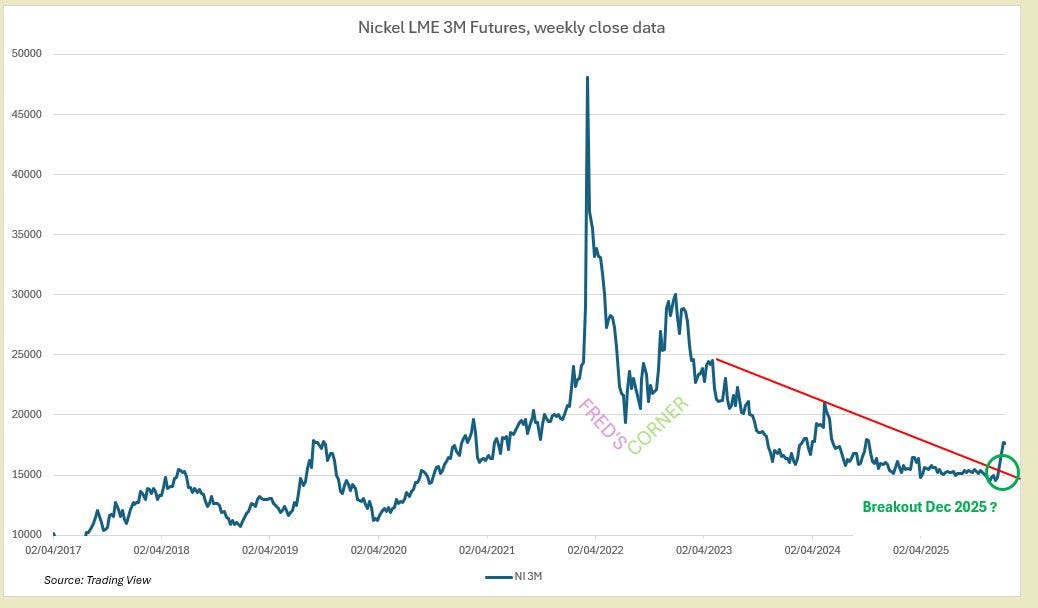
Back to 2017 , I did take a position and luckily benefited from the market trading up 50% in the next year or so.
I then traded in and out of it for a few years until just before Covid.
By then, the electric transition was in full swing, with Tesla making a big run up in late 2019 and early 2020.
I am not good at chasing the “hot latest trend”. So I was looking for another way to invest in the energy transition.
Taking a few steps back, considering various angles, I deemed the “value left” was in the metals at the base of this “revolution”.
Nickel (which I knew then a bit), Copper and Lithium.
This is my main proposition to own the metal.
Nickel can be a cheaper & safer way to play the trend of electrification, batteries and EVs.
Since then, I have owned and traded it. But post 2022 spike, this is only now that I feel comfortable to re-instate a large position for the medium term.
A BIT MORE ABOUT PRICE HISTORY … FUTURES EXCHANGES AND LME CONTROVERSY
I think it’s worth taking a moment to stop at what happened in 2022.
The old gentlemen’s club that is the LME has always been the predominant exchange on which industrial metals are traded. And Nickel is no exception.
As of 2025, about 12 M tons of Nickel were traded on the venue.
That compares with the other rising competitor, SHFE (Shanghai Futures Exchange), which handles about half, or 6 M tons for the year.
If you look at the price history, you will see a decent (humm) spike in Q1 2022.
Nickel Futures on LME surged over 100% on March 8th that year, following Russia's invasion of Ukraine, sparking concerns about metal availability amid potential sanctions on producers. In response, LME suspended trading for eight days and controversially cancelled all trades from that day, prompting a lawsuit from hedge fund Elliott Associates. The lawsuit was dismissed, but LME was fined $12m by the UK regulator for mishandling the chaos at the time.
Following this debacle, volumes dropped, but they have since recovered.
I think it is worth covering: at the time, I asked myself whether I would keep investing in that commodity, if this sort of mess could happen. The answer is that it’s too important a metal to pass. And I think the market has voted unanimously that LME is still apt to handle its business (sic, famous last words !).
Ok, enough about side stories and price history. What does the physical market look like and what is the opportunity today ?
MARKET STRUCTURE: DEMAND
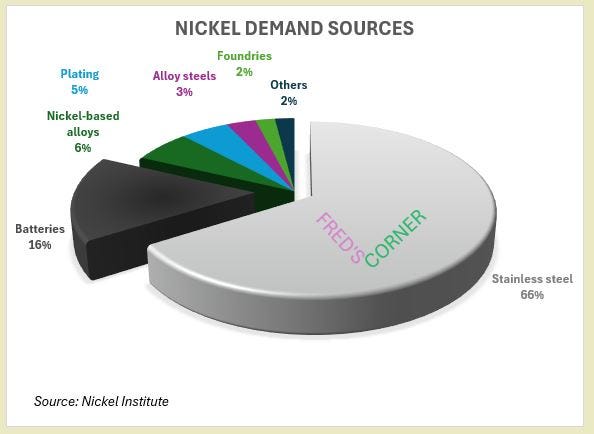
Few facts about Nickel:
it is the 5th most used element on earth
it has many attributes: high melting point, anti-corrosion and oxidant properties, highly ductile …
Over 80% of demand is driven by stainless steel and batteries.
That last part is driving growth.
Whilst stainless steel production has been growing at a rate of 3.5% in the past, battery grade nickel demand has gone up by 23.4% on average over the last 3 years.
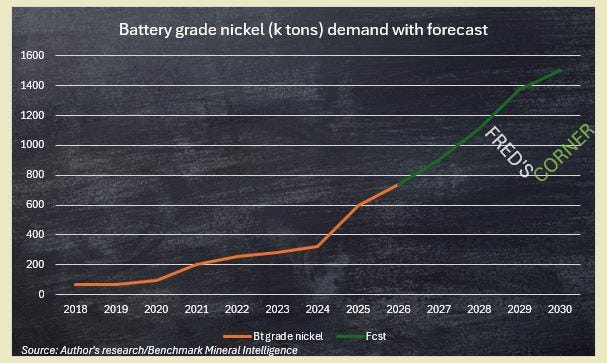
Although demand is not the side of the story I am most excited by, it could get interesting in the coming years.
SUPPLY
Indonesia has become the largest producer in the world by far.
Actually, the dominance it has asserted is unprecedented. In no other large commodity does a country weigh so much on the world supply2:
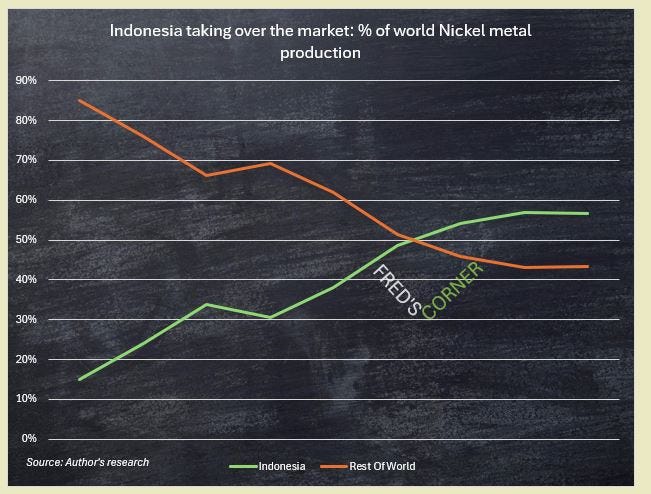
As a comparison, the US produces 12.7% of world oil as the largest producer. OPEC accounts for around 28%.
Indonesia strategy to produce at full tilt, has meant that global supply has outpaced demand over the last 4 years, pushing the market in a continuous downtrend.
In thousands of tons, see below estimates of the oversupply since 2022:
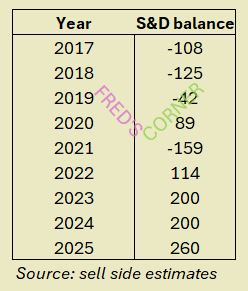
But they may change their tune soon.
Indonesia has been voicing for the last year or so, that they will tackle this issue. In mid-December 2025, they came out with their budget forecast for 2026, with a proposal to cut production quotas by 34%.
In practice that would equate to a drop in Indonesia metal production by over 700 k tons.
Even if the rest of the world were to push year on year production by say 10-15% (not sure they can at current prices), it would put the market in a severe deficit.
By over 450 k tons …
I don’t believe that will happen to such an extreme extent for two reasons:
- Indonesia started to talk about restricting quotas at the beginning of 2025, and yet, year on year production from 2024 was up slightly.
They did not drop quotas (yet) but started to make restrictions on the number of participants.
I think though that when we focus on production costs (more on that later), it is evident that a move will occur to some extent to support prices.
- Commodity markets rebalancing occurs most of the time in a gradual fashion, with iteration between price movements in the underlying, and production responses.
I am taking a few scenarios and think we could see a deficit akin to 2021 of 150 k tons or so.
That caused at the time a price increase of 33% YoY for the metal.
It may not be as extreme as the quotas announced. But given productions costs I am quite confident we will see a production response in the next year or two.
IN THE MEANTIME, WHAT ARE STOCK LEVELS ?
Warehoused stocks at the Futures exchange are quite important for industrial metals.
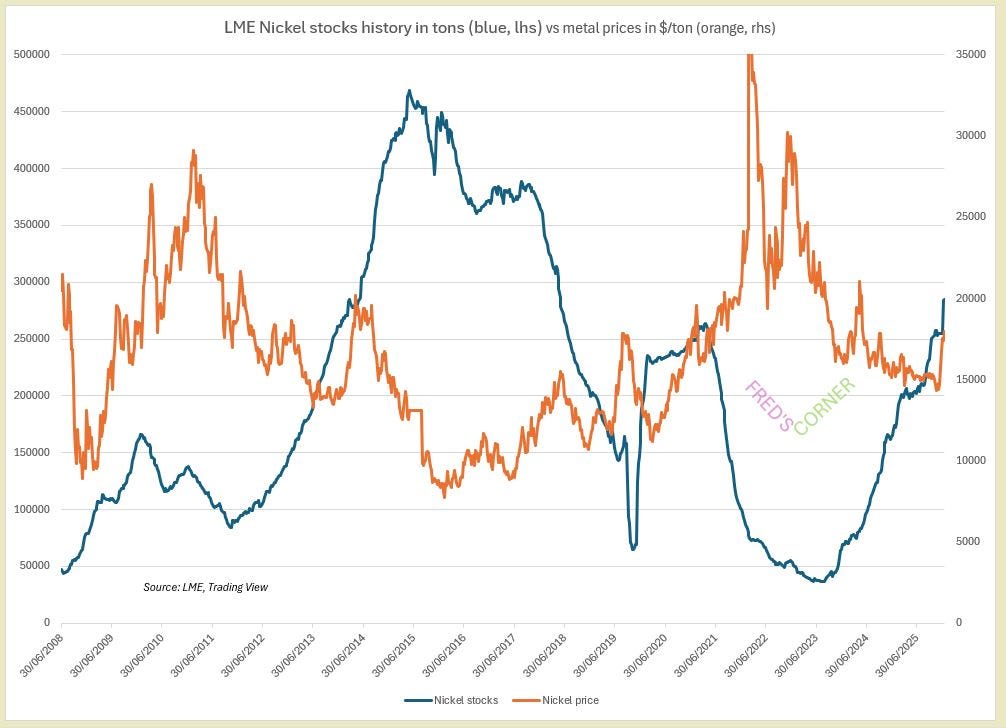
Unsurprisingly, they have been climbing alongside the oversupply noted above.
With or without Indonesia cutting production substantially, we will need to keep an eye on the stock evolutions.
Clearly, we want to see them stabilising and heading down.
WHY ARE PRODUCTION COSTS EQUALLY/MORE IMPORTANT IN DETERMINING THE PRICE TRAJECTORY ?
An overview of the production cost of Nickel worldwide, shows that as of March 2024, 45% of world Nickel production was losing money.
At the time Nickel LME was at 16.8k$/ton …
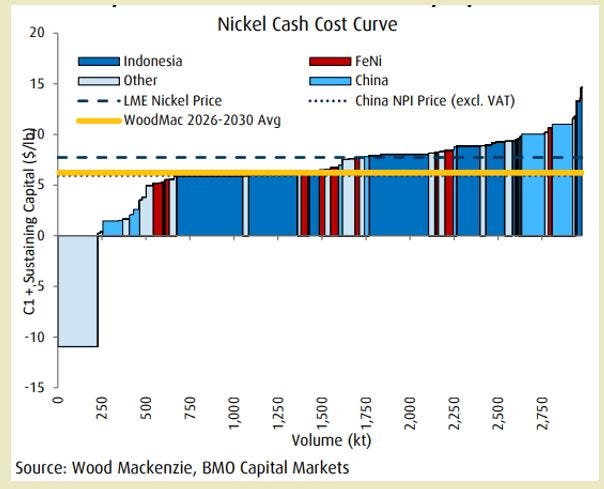
That curve is obviously 2 years old. But it’s a great benchmark after adjusting it for inflation..
If we take a regional approach of inflation in production costs between then and now3, and we translate that into figures in a table, we get the following:
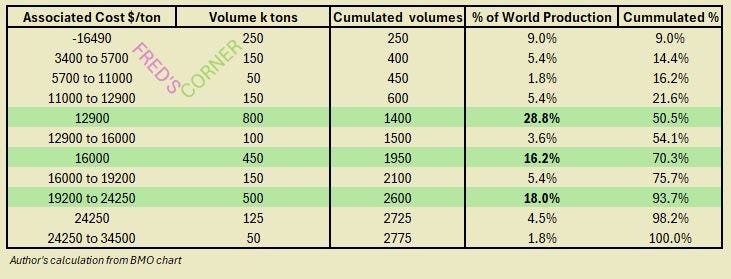
In my view it is a great way to assess our risk/reward and price targets.
Especially over the medium term (6-9 months), as in my experience, on this time horizon commodity prices react to production costs4.
We see three large clusters of volume and associated costs highlighted in green (NB: negative costs are Russian production associated with Platinum, Palladium & Copper’ s credits).
From the above, I don’t see how we can remain in a state of oversupply with prices under 16k USD/ton.
I think it explains the rather more aggressive response the Indonesian government is taking and why prices have popped up steeply in Dec 25/Jan 26.
I think the target “balanced range” should be in the 19.2-24.25 k$/ton region.
That is IF:
Indonesia does not cut aggressively its production as advertised
energy prices remain depressed
and if battery demand does not match BMI forecasts.
Else, I would look at 19.2-24.25 k$/ton to be a future floor for Nickel prices.
RISKS AND BULL CASE
Risks first
As highlighted, we need to keep an eye on the stocks trajectory.
And on Indonesia production.
If the latter does not act and the former keeps growing, then we will again test the lows of last year.
Maybe even go to the 13k$/ton region, which is such a large cluster of production breakevens, I don’t see how we can break through sustainably.
This gives us the downside vs our entry point(s).NB: as discussed on my article on broad Commodities to protect vs inflation, it is important to bear in mind that investing on a commodity for the medium to long term means you need to pay for a roll-yield. It is currently -3.56% on Nickel for a year.
I also mentioned in the article that, in the face of historical moves on said Commodities (and Nickel is no stranger to that), this yield is more than acceptable. This is a given when looking at Commodities. So not a risk per se as far as I am concerned, but it deserves a note here.
I always study related equities to see where the better value proposition and as of now I think the metal alone is a better play.
You may want to consider that, a personal preference, when doing your due diligence.
In terms of bullish arguments I like:
a cheap and fundamental way to play the electrification theme
great risk / reward at or near current levels
political will from the large player we need to see moving
it is not much in the public eye. I see people have started to get interested but it remains so far an unloved commodity even after the current bump.

RISK/REWARD CONCLUSION
As highlighted in my post about solar, I almost always go back to what I can control: the downside.
In the case of Nickel I think the costs table I have extrapolated is quite fitting.
Alongside price movements in 2025, it suggests that we have a strong floor in the 15-16k$/tons region (which could become 19/24k/ton in the future as noted above).
As long as I am convinced that it is the maximum I can lose, I am happy to let the upside take care of itself.
That upside, on my base case, is more limited than in other commodities I have invested in (such as PGMs). Indeed, Indonesia would obviously go back to more production if prices trend much higher (although this does not preclude the occurrence of temporary price spikes).
Having said that, it remains a great risk reward investment.
On a side note, looking at the chart I have followed for years, I think we have a decent chance to go toward 26k later in 2026 or mid-2027 (ie +45% from here). This is the upper bound of a long standing upper trend if we forego the 2022 spike.
And depending on the trajectory of batteries production we could trend higher in years to come.
Given we seem to have broken out of the downtrend, I think it is time to keep an eye on the evolution of what is hopefully a new up trend.
I still love this metal after close to a decade investing in it and especially at current levels !
As always, remember the DYODD
Do Your Own Due Dilligence !
Thanks for reading
Fred
And feel free to ask any questions in the comment’s section. Happy to kick-off some discussions there
The trendline on that chart can be questioned. We will have to see if, unlike Q2 2024, a real trend takes place. That to me, is defined as higher highs and higher lows on the weekly chart.
Maybe in Platinum, where South Africa controls 70% of the world production. But it is a market 35 times smaller.
I looked at inflation rates over the last 2 years, and currency movements, for the 5 predominant producing regions worldwide. I then adjusted prices of the curve accordingly. I think it is a reasonable assumption.
I traded energy for 15 years. In that time, I have witnessed oversupply situations in several markets.
In my experience, people (well bullish ones !) are prone to quote production costs and put a line in the sand that “should not be breached !”. Unfortunately, the price response takes time. And we may go further than expected for longer. I have found a few times over (saw it again in PGMs in 23/24) though that, 6-9 months, is a decent time to see a price response.
I would not take a leveraged position based on that factor alone, especially for the short term. But I definitely invest with a very clear risk reward profile based partially on that as long as I can afford to keep the position for 9 months + … or better with a 1-2 years’ horizon.
Fred!!! I love this. What are the tickers to trade the new Nickel bull market?
Ty Fred much appreciated. I have looked at nickel superficially for awhile, it’s just so annoying that I can’t trade those futs in the US and don’t really like the ETFs either.