
Trader’s Esperanto
A Day in the Life of a Trader and the Language You Won't Learn in Business School


DISCLAIMER:
The article below is part of my “Summer Series”.
As I travel, I have pre-written these pieces to reflect on general trading experiences through a lens that I believe may be of interest.
While I hope this is both informative and enjoyable, it is primarily aimed at people who have never worked as traders on a trading floor1.
If you have, I am not sure how interesting it will be for you, but I would very much welcome your comments, which I am sure could add nuance or challenge my perspective based on your own experience.
It is a long article. If you want to jump to the trading terminology list (there are also additional terms throughout the piece), you can skip ahead to around two-thirds of the way through the article.
INTRODUCTION
The idea for this article came to me while reading a discussion between traders and investors online.
I am part of a Substack chat where a lot of interesting information is exchanged by professionals and retail investors alike. The discussions are generally insightful, with plenty of humour and good-natured banter, thanks in no small part to the personality of the organiser, who is one of the smartest and most likeable traders I have come across.
A few months ago, we started discussing a hypothetical market reaction to a geopolitical event.
People were talking about order books, market depth and bid-offer spreads, yet there was often confusion around some of the most basic concepts used on a trading floor, as well as the organisation of the market itself.
Why you don’t say “Yours !” when you try to buy.
How can a trader quote both a bid and an offer at the same time, even though they may only be interested in buying at that level?
What surprised me was not that newcomers were confused. It was that even experienced investors and very knowledgeable retail traders seemed puzzled by concepts that any professional trader would consider natural.
I thought it might be both informative and entertaining to explore this language, along with a few anecdotes and an explanation of how information and orders flow between the various participants in a market.
Hopefully, it will provide an interesting perspective for readers who have never experienced life on a trading floor.
A DIFFERENT PLANET WITH ITS OWN CODES
What would a trading floor look like to you if you stepped onto one for the first time?
An impression of chaos.
I like the jungle analogy, even though it was also used as the cover of my last article (!).
But yes, a trading floor can feel like mayhem to outsiders.
It can be very noisy and chaotic.
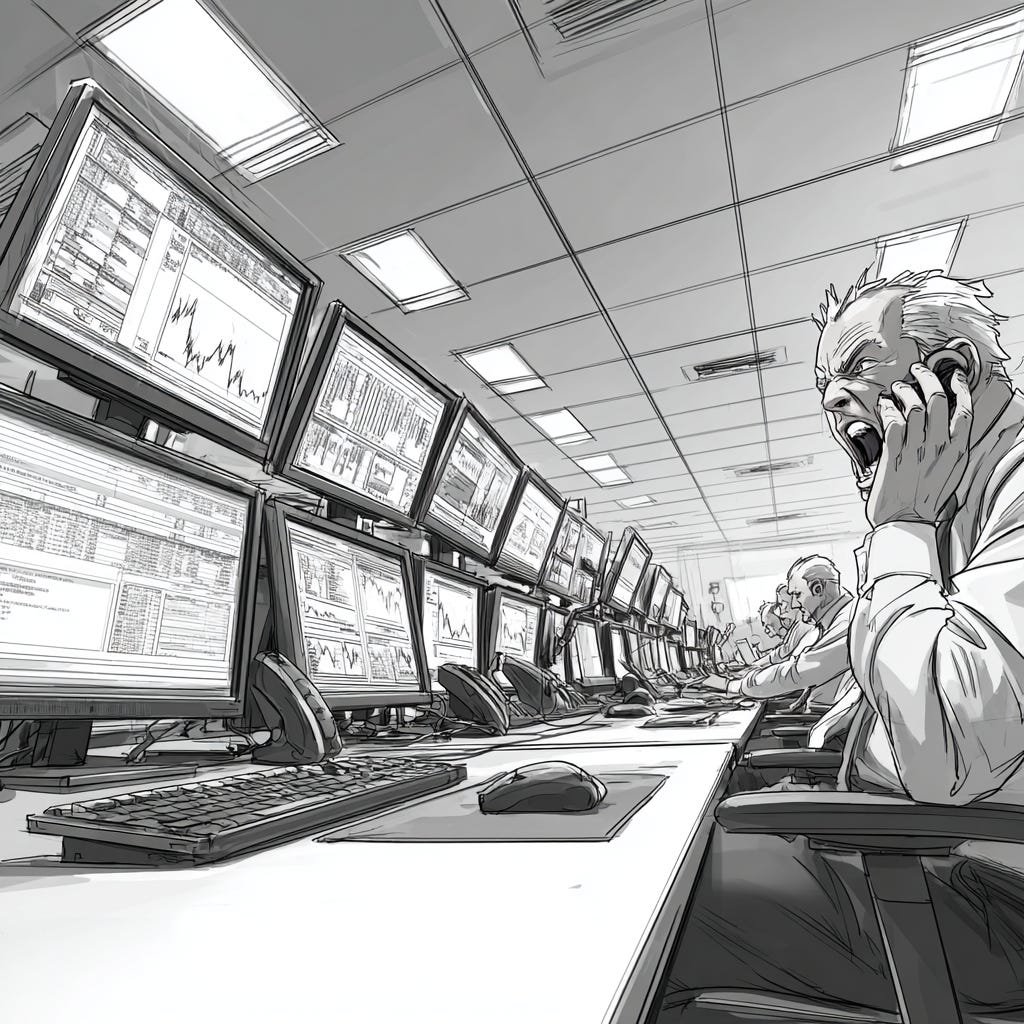
It can also feel like a different planet.
Human beings surrounded by multiple computer screens, speaking a foreign language.
Words you know, but shouted rather than spoken, in single words rather than full sentences.
Fast.
Everything would sound like coded military jargon.
…
“20 at 25.”
“Mine!”
“Double!!”¹
…
Finance professionals across banks, hedge funds, brokers, and macro funds speak a highly compressed operational language.
It functions almost like Esperanto: a shared dialect across countries and institutions.
Retail investors see markets through charts and narratives.
Institutional traders see positioning, liquidity, execution, flows, and risk transfer.
While I want to share my experience from a trader’s perspective, this microcosm is made up of a number of different actors with distinct functions.
Let us briefly describe them before explaining what an order book is, in order to build a clearer understanding of how markets actually function.
FIRST OFF: WHO ARE THE PARTICIPANTS?
There are many more roles on a trading floor (salespeople, trading assistants, commodity operators, analysts, quants, etc.).
But for the purpose of this article, we are only interested in those with a mandate to execute, namely traders and brokers.
TRADERS
Traders are responsible for risk.
Portfolio Managers (PMs) manage a “book”, i.e. a portfolio of positions, by allocating and managing capital provided by their firm.
Flow traders execute client orders from institutional clients. They may still take some market risk, but with significantly smaller limits than PMs. They are typically found in banks.
BROKERS
Brokers act as intermediaries between traders.
While most trading is now electronic and anonymous on exchanges, many markets still involve brokers in bilateral transactions where counterparties are ultimately disclosed.
On electronic screens, only the broker’s name is visible.
Once a trade is executed, the actual counterparty name may then be revealed.
Brokers therefore act as information intermediaries. They are paid for facilitating “best execution” in a confidential manner.
They know:
who is buying
who is selling
who is showing interest
Without necessarily revealing identities, or the full picture they hold.
THE SCREEN AND THE ORDER BOOKS
Ok !
After this explanation of who is who, what does a trading screen look like to a professional trader?
Let me use the example of the European energy markets.
The image below is a public screenshot from Trayport2, which has been providing trading screens for gas and power traders since the liberalisation of these markets.
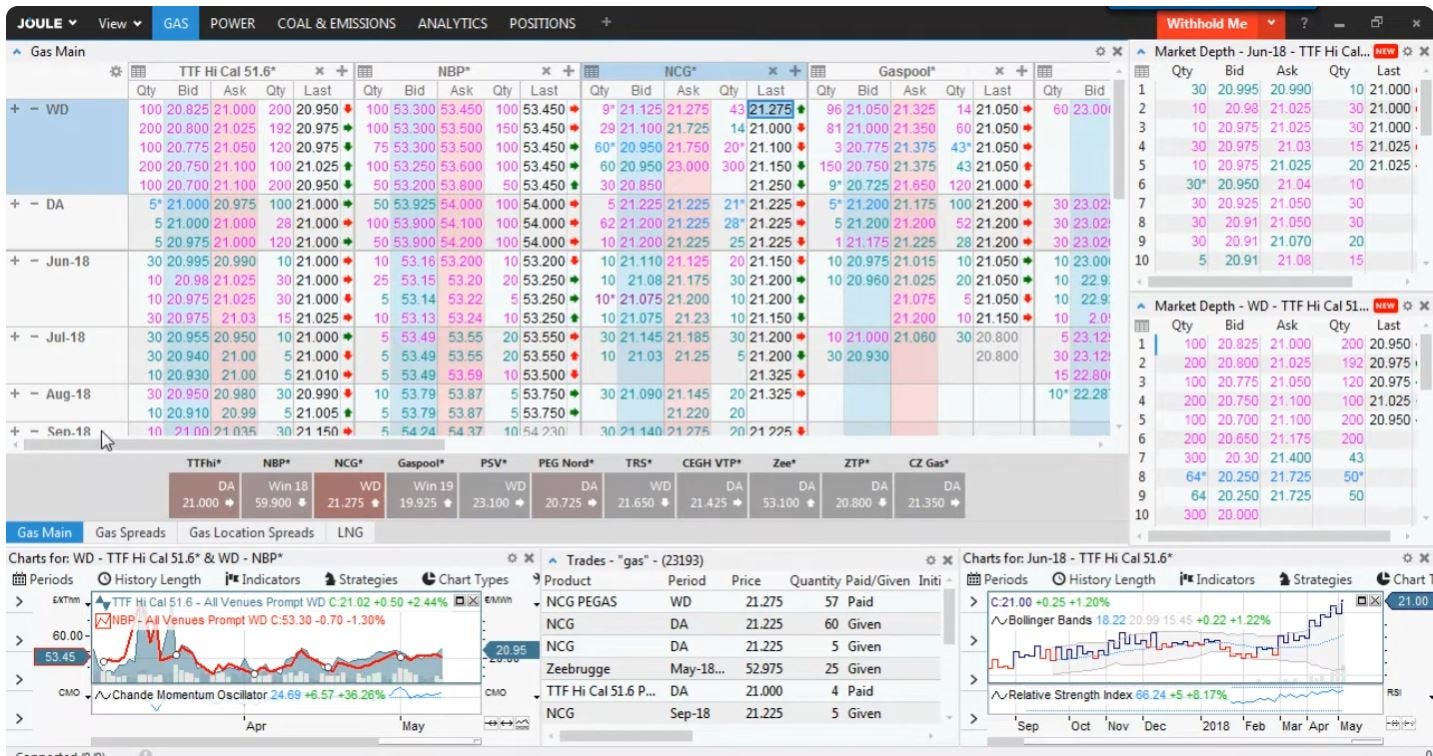
Lot of numbers!
And that is only part of what I used to see in front of me. I typically had two large screens, out of six to eight in total, dedicated solely to prices like this.
Numbers would flash every time prices were updated or trades were executed.
A lot of flashing. All day long.
It is not easy for the brain to make sense of it and keep track of everything, but I will describe that experience in a future follow-up article.
Anyway, that screen shows prices for the main European gas hubs3.
Anyway, that screen shows prices for the main European gas hubs³.
European energy markets are somewhat special in terms of execution, but they also reflect many of the structural features seen across other financial markets, making them a useful example in my view.
While we used electronic screens like the one above, many of these instruments are OTC or forward contracts.
OTC stands for “over-the-counter”.
It refers to financial trading that takes place directly between two counterparties, rather than through a centralised exchange (such as the NYSE or the LSE).
We also traded Futures, listed contracts that are integrated into the same platform.
These would typically appear under “EEX” or “ICE” (the two main exchanges), displayed via the broker feed, to distinguish them from OTC instruments.
The platform provider has removed one important column from the image shown here: the broker acronym.
If you look at NBP (second column, UK gas) for June 2018, for example, the best bid (i.e. the highest buying price) would normally be associated with the name of a specific broker.
As traders, we would therefore know exactly which broker to contact if we wanted to negotiate or handle post-trade execution matters.
In a real trading environment, that 20.995 bid would typically be associated with brokers such as ICAP, Marex, or EEX, among others.
If I wanted to check whether the 20.995 bid could be improved, I would contact the broker showing that price.
WHAT ARE “BIDS” AND “OFFERS” ?
For each product, for instance NBP June 2018, a contract for delivering gas in the UK hub during that month, there are multiple prices in the market.
The “market” is not a single price, but a range of bids and offers across participants.
However, the most competitive prices are the ones typically quoted by brokers.
In this example, the broker might show a bid at 53.16 and an offer at 53.20.
The bid is the price at which someone is willing to buy a product.
The offer is the price at which someone is willing to sell it.
The spread is the difference between the bid and the offer.
NOT ONE PRICE, BUT MANY
If we look at retail trading in equities, most people refer to “the Microsoft share price” of, say, $443.
But in reality, as a trader, there is no single “price”.
There is a last traded price, alongside multiple simultaneous bids and offers, which provide the true “colour” of the market.
In highly liquid and stable markets, this distinction may not matter much.
But in fast-moving or illiquid markets, the bid and offer at any given moment become crucial.
As well as the depth of the market.
To illustrate depth, let us zoom in on an order book.
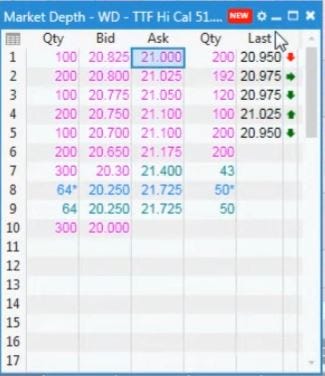
In the above, we see prices for “Within Day” Dutch gas, i.e. gas to be delivered on the same day it is traded.
Every number on that screen is important:
The last traded price, of course
The level of the best bid and offer
The quantity available at the best bid and offer
The total volume available on both sides (at least around the current price level)
These volumetric indicators give you a sense of “depth”, i.e. how much you can buy or sell before moving the market.
They also provide a measure of liquidity: how much can be transacted at or near the last traded price.
The entire “stack”, i.e. the full order book displayed above, gives an indication of potential imbalance.
Visually, as shown here, it leans to the left, suggesting, at first glance, that there are more buyers than sellers.
As traders, we watch screens like this all day, as markets evolve continuously.
You do not want to miss the action.
When a lot of trading activity occurs in a given contract or product, i.e. when numbers are flashing, you know there is interest, flow, and potentially an opportunity to participate.
If news comes out and you believe it is tradeable, you ask yourself: has the order book shifted instantly, or can you be the first to act? (In most highly liquid markets dominated by algorithmic trading, this is unlikely, but it still exists in many commodities and thinner markets.)
And then there is the “colour”: i.e. what is not visible on the screen.
WHAT “COLOUR” BROKERS CAN GIVE
Beyond what is displayed on screen, you can ask brokers to negotiate a price for a specific volume.
As a professional trader, you need to be careful about how much information you reveal, i.e. whether you are showing your full interest or only part of it.
Brokers may give preferential treatment to certain clients, even if unintentionally.
So it is partly a game of trust and information management: how much to show, and to whom.
Even with a strong relationship with a broker, information can still leak: another desk, or a colleague, may hear something and pass it on to their own clients.
Yes, there are many games being played…

In any case, if the market is trading in lots of 10 and you need to buy 1,000, one option is to go to your broker and ask them to “look for size”.
You might ask them to find an offer for 1,000, for example.
The price will likely be higher than the best level shown on screen, but that is your decision to make.
You can also ask them to work your order “on voice”, meaning they would quote it via the squawk box (more on that below) to other clients.
As with bilateral trading on screen, your voice order is your commitment, so you need to be careful (more on that later).
Brokers can therefore work orders off-screen on your behalf.
Secondly, since brokers often have significantly more information than any individual trader (because they receive flows directly or via colleagues) you can also ask them:
“How much is on the bid/offer?”
In our WD TTF Gas example, the offer may show 200 at 21.
But the seller may have told the broker they are actually willing to sell 300. The broker may also be able to confirm this or update it.
Similarly, other traders who were not first in the queue may try to “join the offer”, and the broker is aware of this.
At times, brokers may also indicate what type of participants are behind a price. This categorisation can help the trader on the other side decide whether they want to trade.
In principle, brokers should not disclose this information, nor should traders use it for decision-making, as a price is a price. But in practice, it has often happened, and still does.
THE BROKER BOX (TURRET)
This is how information was flowing between brokers and traders beyond the screen.
The turret looks like a cross between a telephone exchange and a fighter pilot’s cockpit.
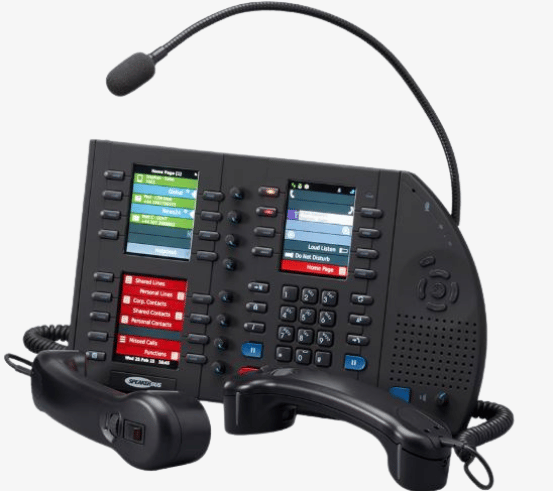
Maybe more fun and impressive, my own Turret back then (!)
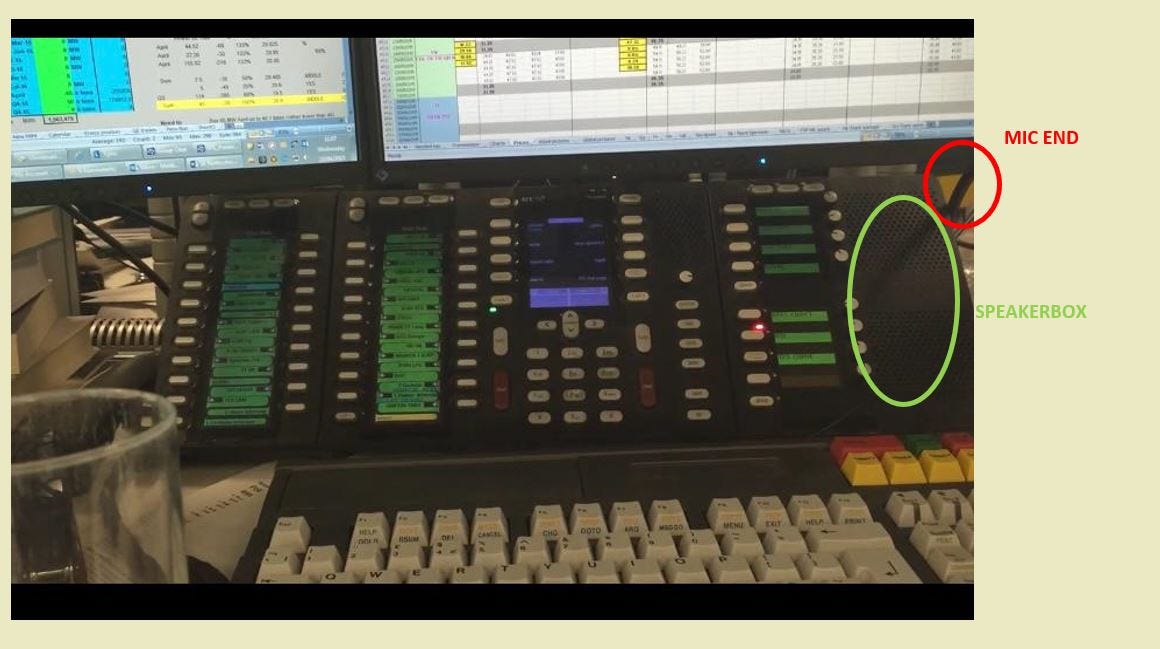
Every morning, each broker would call us on a direct line, which we would then plug into the “box” and keep open for the entire day.
The “box”, or squawk box, is a voice communication system that allows a broker to broadcast information simultaneously to dozens, sometimes hundreds, of traders.
As a result, we would hear throughout the day the four to six brokers connected to our box shouting prices continuously.
It gave us, as traders, a real-time audio picture of what was happening across the market at any given moment.
We could “pick up a line” by switching the connection from the box to a headset, allowing a one-to-one conversation if needed.
Alternatively, we could press a button and speak directly into the box, so that all connected traders could hear the discussion (hence the microphone function).
That small device contributed significantly to the overall sense of controlled chaos on the desk!
LIST OF MAIN EXECUTION WORDS AND JARGON USED
After this detailed explanation of who does what and how, let’s finally go through the “Esperanto” of the trading floor and give a number of examples commonly used in practice.
This is not exhaustive, but it should cover the main expressions used.
25 bid at 50: the broker indicates they are quoting a market, i.e. they can buy at 25 and sell at 50. This is generally expressed in decimals. For example, if a German power price for next year is 93 euros, this might mean they can buy at 93.25 and sell at 93.50
I am 25 at 50: same meaning
at 50: I am selling at 50
60 offer repeats: the market is 50 at 60. You tell the broker on voice you can pay 55. The seller indicates he does not move from his 60 offer
I join the offer: the trader signals to the broker that they are willing to join an existing seller at a given price level (often first seen on screen, but sometimes via voice)
55 choice: the market is simultaneously willing to buy and sell at the same price. As a trader, you therefore have the choice to either buy or sell at that level
where do you come from?: you have asked on voice to the broker where the market is (ie where is the best bid/ask spread). They want to know if you are looking to buy or sell
what’s your size?: the broker asks how much volume the trader is willing to buy or sell at the quoted level
how much do you have on the offer/bid?: same
I am paying [price]: the broker indicates on voice that they are willing to buy at a given price
working your order: the broker indicates they have taken your order and are working it (likely on voice, i.e. off-screen, shouting it to their client list via the squawk box or discussing it with a few counterparties)
lifted: someone took the offer, i.e. the trade occurred on the offer side of the market
given: the opposite. Someone hit the bid at that level (i.e. sold the price shown on screen or voice)
done: the price has traded at your level; you have bought or sold at the price given to the broker
you are done: same meaning
bid on: someone just sold at the level I was willing to pay, and I am now paying the same level again
offered over: opposite. Someone bought where I was willing to sell, and I am now re-offering at the same level
who’s my buyer / seller: the trader asks the broker who the counterparty was on a trade. The broker provides a name, which is then recorded in the trading blotter for end-of-day reconciliation of positions and trades
I trade at [price]: when a broker works a trade (on screen or voice), they will announce the executed price via squawk box to all connected participants
taking out the offer side: a trader lifts, ie buys, all available volume on the offer across multiple price levels
off the offer! / off the bid!: when the market moves quickly higher, traders use this expression to indicate they are rapidly removing offered liquidity
And some fun expressions coming quickly on top of my head!:
“Sky is the limit when pigeons are short” (used in sharply rising markets)
“My prices are not doorstops”: used to tell a broker they cannot keep working your price indefinitely; you are forcing a decision from the other side
MARKET CODE OF CONDUCT
Beyond the “lingo”, I have realised there are two things that are not obvious to non-professionals when I speak to retail traders.
First, there is an unwritten code of conduct that we adhere to.
While nothing is legally binding, it is the accepted way of doing things.
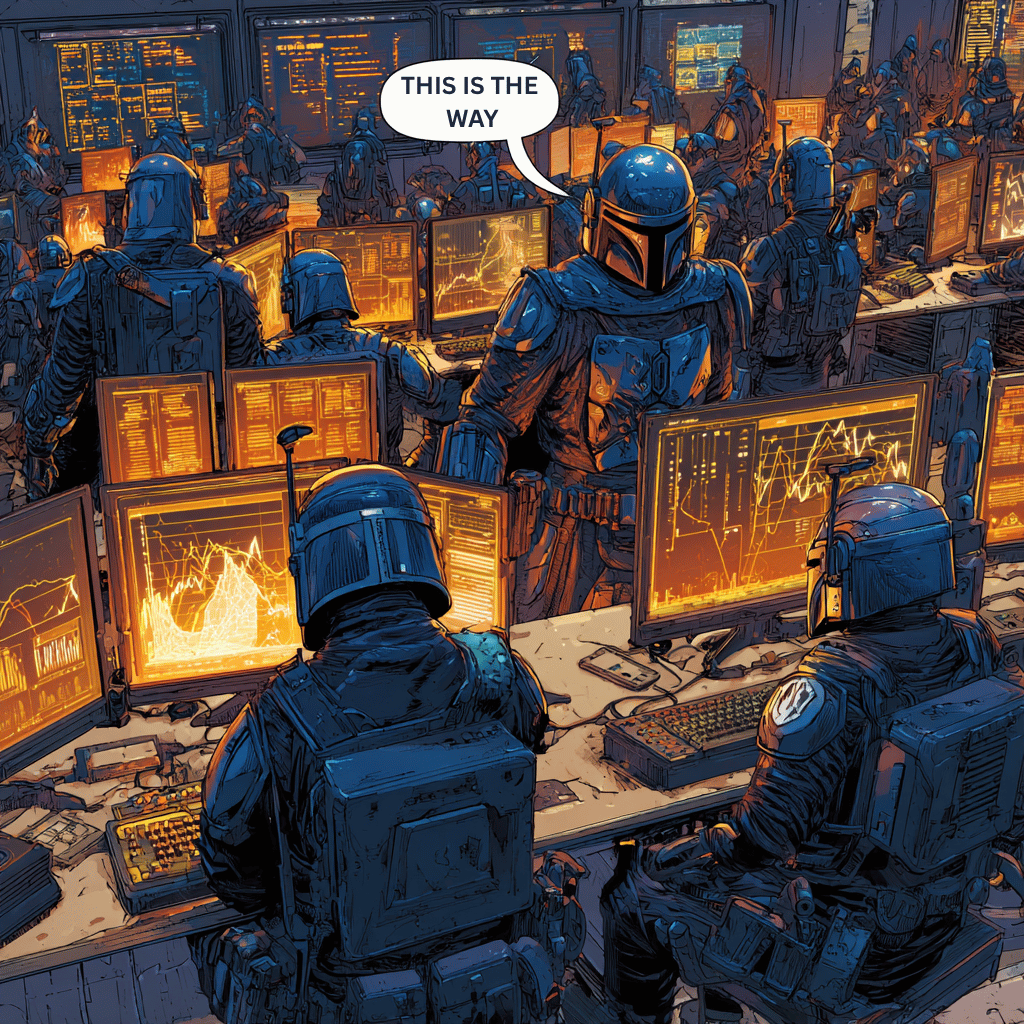
I like the Mandalorian analogy.
The main principle I am referring to is that when you give an order to a broker, whether on voice or on screen, you stand by it. Your word is effectively your bond.
It would occasionally happen that traders would make a mistake and input the wrong bid or offer.
They would get filled immediately at those levels.
In many cases, unless you know and respect the counterparty, and unless it is a very calm market or an obvious error, your counterparty would most likely hold you to the trade.
In other words, the trade would stand, even if it costs you money.
If there is a clear and obvious mistake, a decent trader may “let you out”, i.e. cancel the trade and move on.
But you need to act quickly. Otherwise, the market absorbs that trade as information, and it becomes much harder to unwind.
If you dislike a counterparty (which also happens), they may still choose to hold you to the trade even if an error is obvious.
I remember a colleague of mine who was particularly arrogant trading against one of the major US investment banks.
He made a costly mistake, and given his attitude, as conveyed through the broker, the bank refused to let him out of the trade, despite our head of trading calling theirs and long, heated discussions.
It was costly.
And not the kind of reputation you want to build with your own management either.
So in my experience, regardless of the market, if on your first day of trading you get the direction wrong… well, you have a position on!
PRICE DISCOVERY AND MARKET MAKING
Secondly, even if you believe a security should trade at a much higher price than where the current bid/ask sits, you should always be in a position to sell.
Going back to a trader group chat, we were discussing a theoretical market: the probability that the Strait of Hormuz would remain open in two months’ time.
Many participants in the chat thought the probability was close to zero, say 5 to 10%.
When someone mentioned that a probability quote on Polymarket was around 45%, they were reluctant to quote our own internal “fun market” better than 0 at 60% …
In other words, they were willing to bet that the probability was above 0% (which is not a particularly strong conviction), but below 60%.
My comment at the time was: *“You guys are quoting wider than Drake’s Passage!”3.
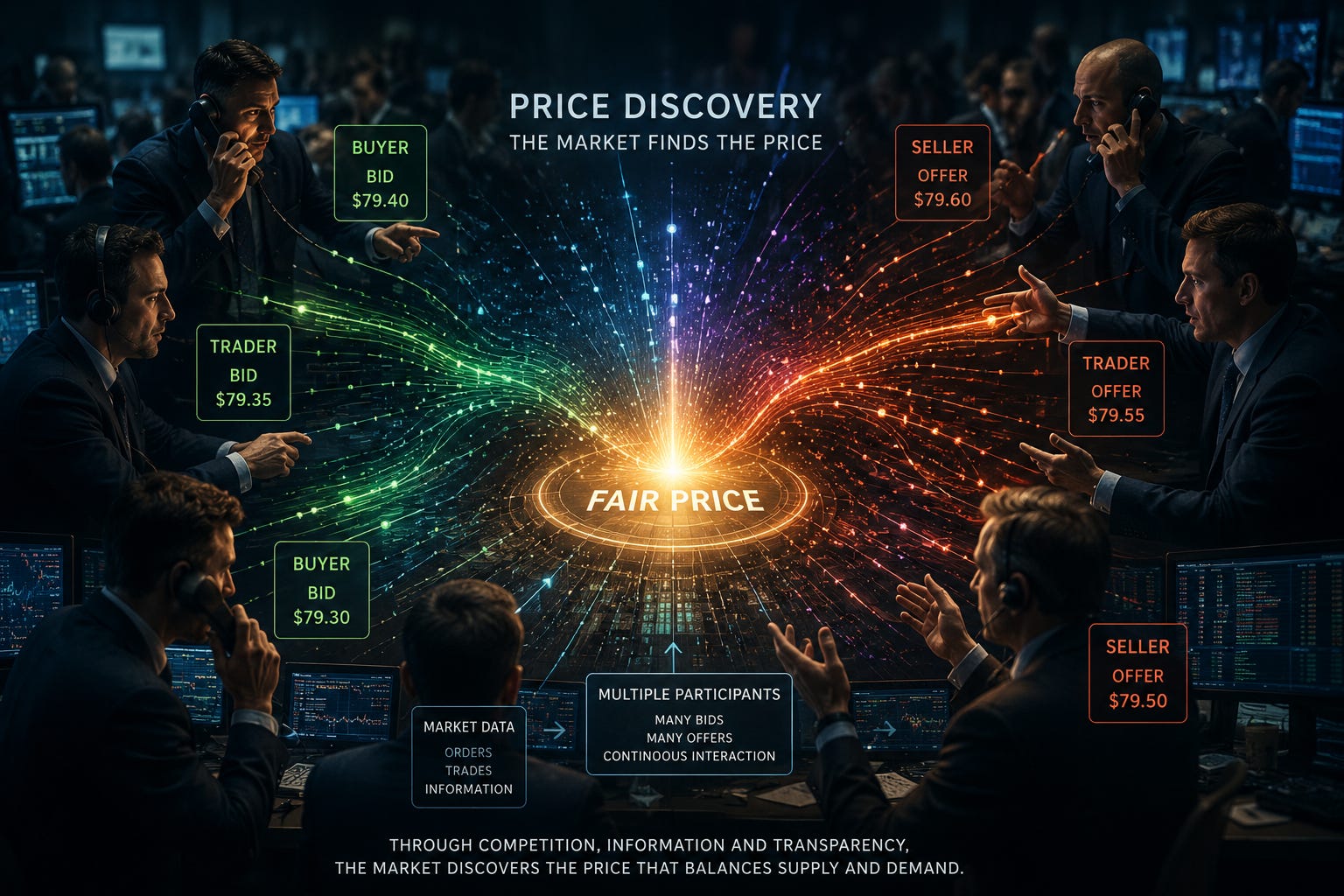
Having traded relatively illiquid markets for most of my career, I became used to quoting both sides, i.e. showing a buy and a sell price on a product every morning, just to get the market moving.
I only recently realised that most people do not understand why one would do that.
Liquidity begets liquidity.
When other traders see prices, they engage.
This process of price discovery and “forced market-making” (even though I was not a formal market maker, I often had to behave like one) is essential.
As a portfolio manager, I was ultimately expressing a directional view, betting on the market going higher or lower. But I still needed to be willing to transact both ways to generate liquidity.
You then typically find that you are able to implement your position, you just need patience and focus.
Back to Microsoft stock: none of this is necessary there.
It is extremely liquid, and you can generally trade the size you want at any time (unless you are Berkshire Hathaway and effectively own 10% of the float!).
But in many less liquid markets, as a professional trader, you do not have a choice.
You have to get the ball rolling.
CONCLUSION: WHY THIS LANGUAGE STILL MATTERS
Traders still communicate using a condensed language because markets reward speed, precision, and shared understanding.
Short expressions also carry information about positioning, emotion, liquidity, volatility, and risk appetite.
This “Trader’s Esperanto” remains one of the few professional dialects understood by thousands of people globally, and by almost no one outside the industry.
It can be compared to aviation language or military jargon: fast, compressed, and coded.
While it may not be the most intellectually complex part of investing or trading, these behaviours and this code are what make the environment exciting.
It is a unique experience to operate in such a fast-paced world.
I hope you enjoyed this and that it gave you a sense of what it feels like to sit on a trading floor.
Next time, I will share more of my own story and how I became a portfolio manager.
Thanks for reading,
Fred
I apologise in advance, but I will use many “quotes” in the text below to highlight specific trading jargon.
This is not recent (2018) and is extracted from a promotional video by the platform provider on YouTube.
For reference, this refers to the widest maritime passage in the world ! As I mentioned, a bit of trader banter 😊