


TLDR Key Takeaways
Back on the shopping list: After a spectacular rally in 2025 that led me to exit my positions, palladium has fallen back into its 2023–2025 consolidation range. A second medium-term entry opportunity in less than a year?
Fundamentals more resilient than expected: The EV transition has not destroyed automotive PGM demand as anticipated. Hybrid sales have surged, recycling continues to disappoint expectations, and mine supply remains under pressure, notably in Russia and North America.
Speculative positioning is becoming extreme: The unwinding of the 2025 rally, combined with broader precious-metals weakness, has pushed palladium speculative positioning towards historically bearish levels. Yet supply-demand balances are far from showing a massive surplus.
An attractive medium-term risk/reward: Mining cost curves suggest limited sustainability of current prices over time. Short-term selling pressure, particularly from CTAs, could continue, but I see the current correction as an opportunity to rebuild exposure rather than try to time the exact bottom.
INTRODUCTION
I started to get interested in palladium in mid-2024.
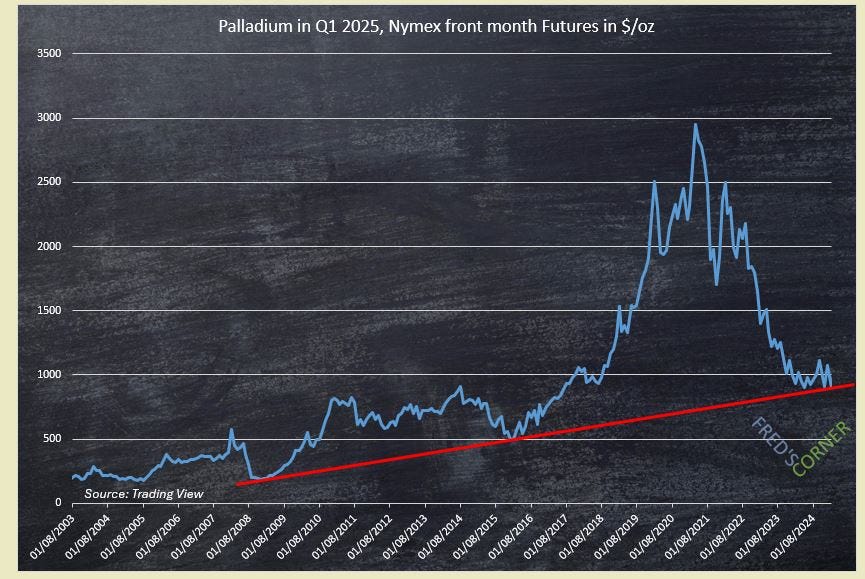
What attracted my attention was that we were near the bottom of a slowly rising trend that started in 2009.
I initiated a position and had to trade back and forth around it as it did not seem to break out of a consolidation phase that ended up lasting a year and a half.
By the time I kept telling people around me about it, the chart looked like this:
If we zoom in, this was the consolidation rectangle we were in:
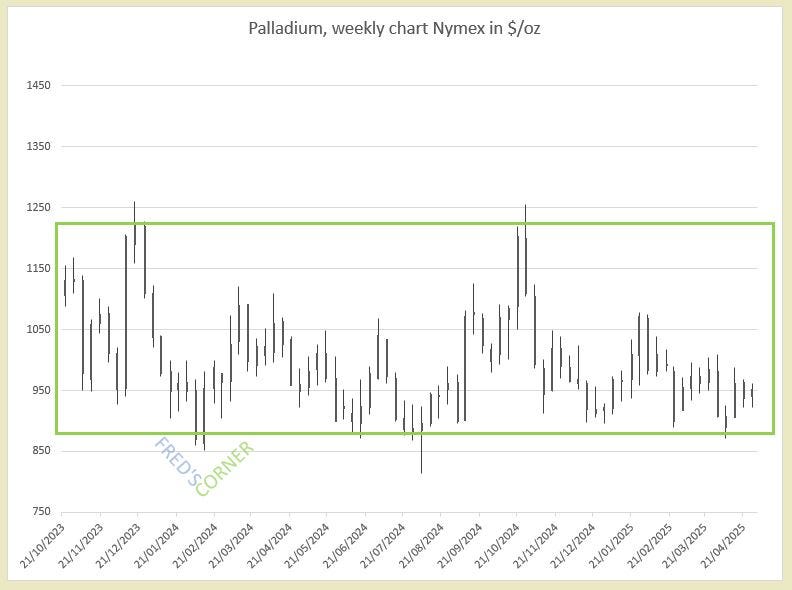
So it was a decent tradable range.
After building a respectable position, I realised that platinum maybe had better fundamentals (more on that later).
The chart at the time looked like a large coil (potentially a very bullish structure):
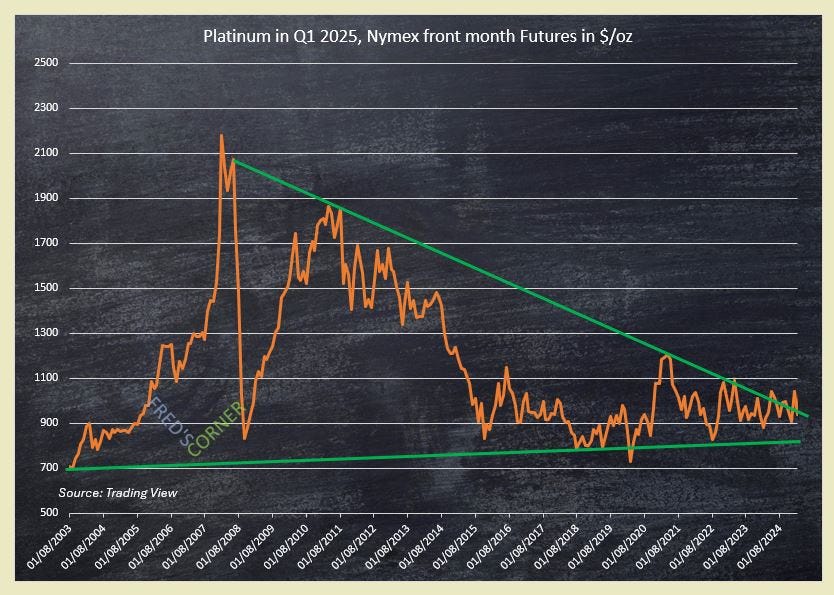
In May 2025, platinum broke out of that long-term coil.
This was followed in Q3 2025 by palladium breaking out of its range.
The duo rocketed higher so fast that I closed out all my positions in Q4 2025.
Amazingly, we are now back down near the bottom of the channel in palladium:
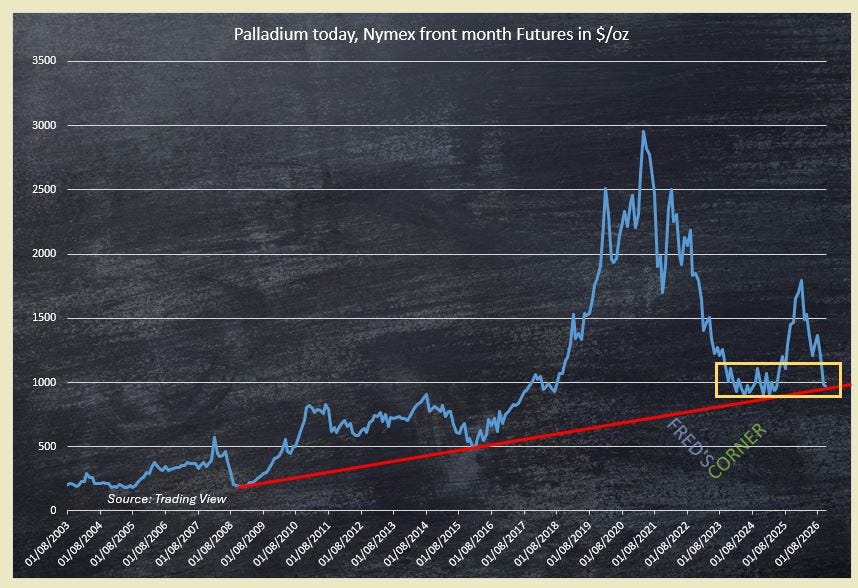
And back into the 2023–2025 consolidation range.
The one I now refer to as the orange “penalty box” (the rugby one, that is).
Hard to believe that, less than a year later, we could find another medium-term entry point. So I thought I would write about it and describe the case for it.
WHAT ARE PGMs AND WHAT ARE THEY USED FOR?
Platinum and palladium both belong to what is commonly referred to as the Platinum Group Metals (PGMs), alongside rhodium, ruthenium, iridium and osmium.
They are primarily used in industrial applications, particularly automotive catalytic converters, thanks to their exceptional catalytic properties.
World demand is forecast to be about 9.25 million oz for palladium and 7.4 million oz for platinum this year.
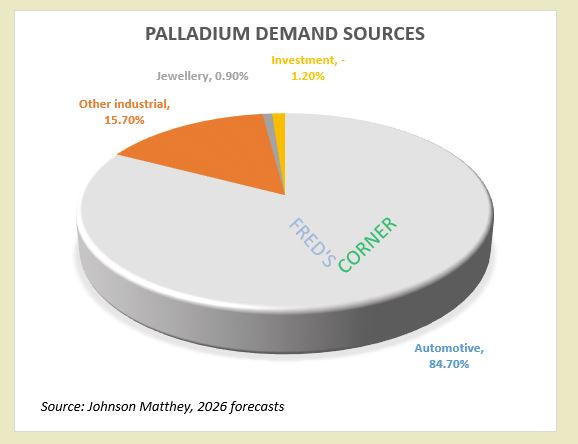
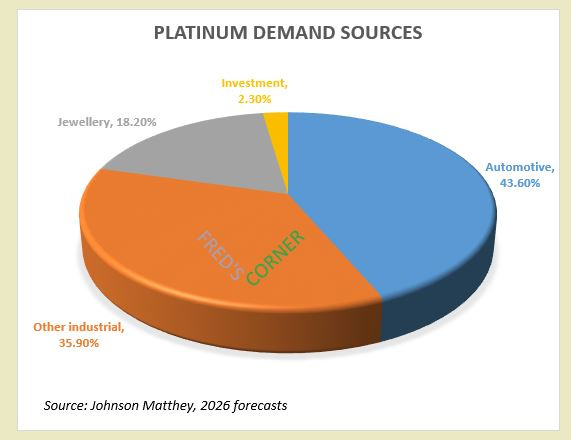
As a background, sentiment was weighing heavily on both metals due to forecasts that the transition to EVs was, or was about to, cause a significant drop in demand and leave the PGM complex oversupplied for years to come.
It’s not exactly happening:
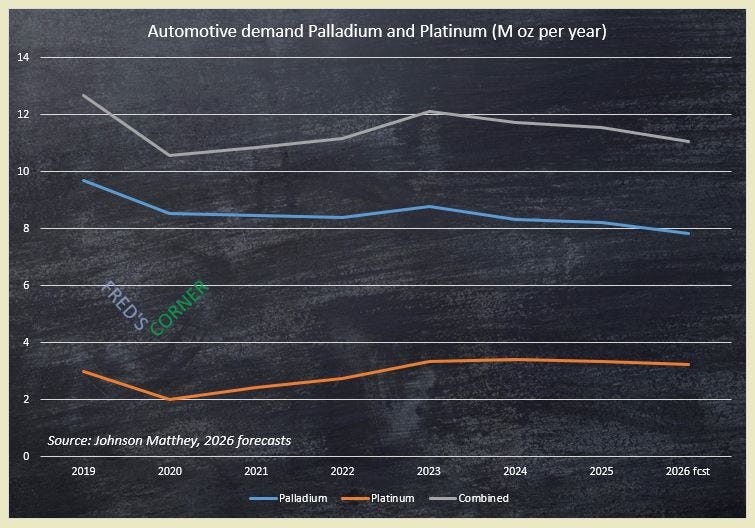
Note that the 2025 forecast was where the 2026 forecast now stands.
Reality is turning out better than expected.
TRANSITION FROM ICE TO EV HYBRID
The real evolution of interest is the composition of automotive demand.
One of the major bearish arguments for PGMs has been the expected rapid transition from internal combustion engine (ICE) vehicles to electric vehicles (EVs), which do not require catalytic converters.
But things have not quite played out as expected.
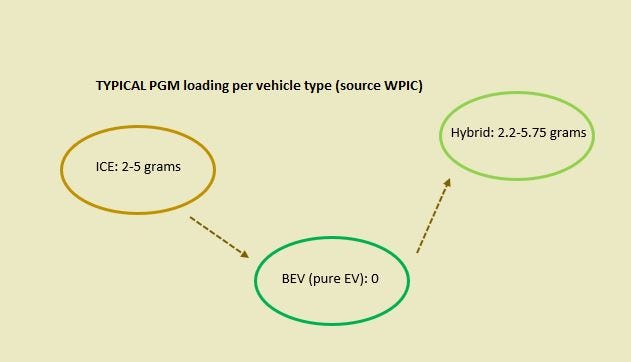
ICE vehicles have proved more resilient than anticipated, whilst hybrid vehicles have seen a remarkable surge in sales, taking market share from both traditional petrol cars and fully electric vehicles.
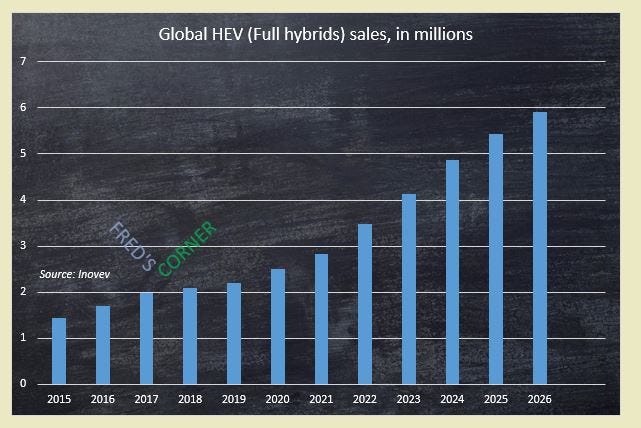
And here’s the interesting part: hybrids still require catalytic converters and, in many cases, have higher PGM loadings than conventional ICE vehicles. This is partly because their engines frequently switch on and off, making it harder to maintain the temperatures needed for efficient emissions control.
So whilst EV adoption continues, the rise of hybrids has helped support automotive demand for platinum, palladium and rhodium, making the decline in PGM consumption considerably slower than many had anticipated.
A WATERFALL OF RECYCLING?
On the other side of the equation, it had been expected since 2022 that the market would face a deluge of scrapped catalytic converters, bringing much more recycled palladium onto the market.
The recycling recovery has repeatedly disappointed expectations since 2022:
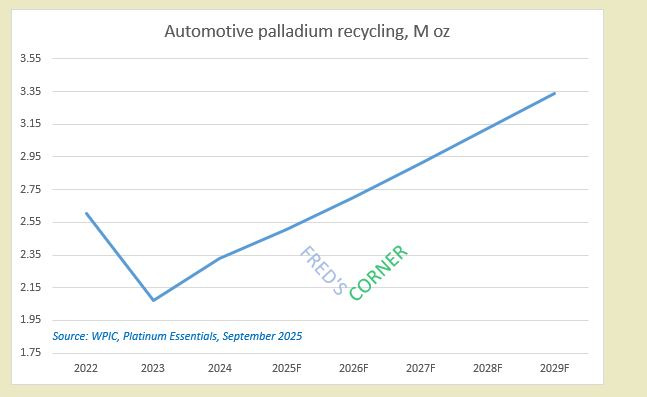
Given that recycling depends on prices, it’s safer to assess the risk/reward of buying Palladium at current lower prices with this part of the supply and demand equation in mind.
An important factor that therefore helps make the current entry level compelling.
Secondly, recycling has been slower to pick up as vehicles stay on the road longer.
Recycling volumes (for both metals) fell sharply in 2023 due to a shortage of end-of-life vehicle scrappage and a steep decline in metal prices, which incentivised scrapyards to hoard spent catalytic converters.
WHAT ABOUT MINE SUPPLY?
Interestingly, it is not exactly booming either.
Nornickel, the world’s largest palladium producer, expects production to fall by around 10% this year, partly because of lower ore grades and operational difficulties replacing Western equipment.
That number alone (slightly above 300,000 oz) is larger than the current anticipated market surplus forecast by Johnson Matthey for the year.
In North America, high-cost production has been closing or reducing output, whilst South African mines continue to struggle with ageing shafts, underinvestment and operational disruptions.
So whilst everyone has been talking about declining automotive demand and a wave of recycled metal coming back to the market, primary supply has actually been moving in the opposite direction.
And that is before considering how much of the anticipated recycling recovery will actually materialise.
PUTTING THAT ALL TOGETHER
Looking at the combined balances for both metals, we get the following picture from the WPIC1:

WHAT WAS THE Q4 2025 SPIKE ABOUT?
The sharp rally was driven by a combination of physical market tightness …
US tariff fears created a physical squeeze: Following tariff threats, traders moved physical platinum and palladium into US warehouses ahead of possible restrictions
That pushed lease rates higher2, creating tighter physical market conditions.The EU proposed softening its 2035 combustion-engine restrictions: That was interpreted as extending the commercial life of combustion-engine and hybrid vehicles, which continue to require catalytic converters.
For palladium, which is especially dependent on petrol-engine catalysts, this was a meaningful improvement in the longer-term demand narrative
However, the policy was a proposal, not a final enacted reversal of the EU rules.
… and speculative flows:
China launched domestic PGM Futures trading: on 27 November 2025, the Guangzhou Futures Exchange launched platinum and palladium futures. Ahead of the launch, physical metal was reportedly flowing into China to support the new contracts.
Precious metals investment demand surged: As illustrated by the very strong rallies in gold and silver that year. But also, after several years of depressed sentiment (cf. the EV transition narrative), short-selling had been prevalent in the sector. During 2025, some of those positions were unwound, whilst ETF holdings rose above 1 million ounces in Q4 2025.


WHY THE SUDDEN REVERSION IN PALLADIUM PRICES?
I think there are two things at play.
First, the extraordinary rally in late 2025 was partly driven by temporary factors: US tariff-related stockpiling, physical market tightness and speculative inflows. Those have since largely reversed.
Secondly, the broader precious-metals complex has come under pressure as US interest-rate expectations shifted towards further tightening.
And here’s the interesting part.
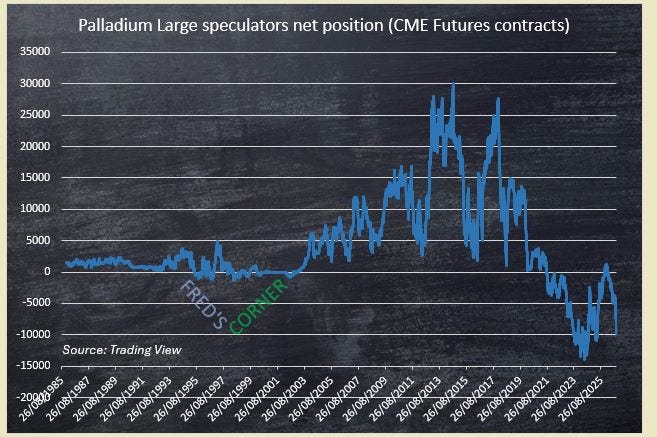
Speculative positioning in palladium has become extraordinarily bearish. CFTC data show managed-money net shorts more than doubling between early September and mid-October.
All this against a backdrop of the same familiar concerns: declining automotive demand and an expected wave of recycling.
Yet actual automotive demand has proved rather resilient, whilst the anticipated recycling recovery has repeatedly disappointed.
So perhaps the fundamentals haven’t deteriorated quite as much as the price would suggest.
And that is precisely what makes me interested again.
POSITIONING ZOOM-IN
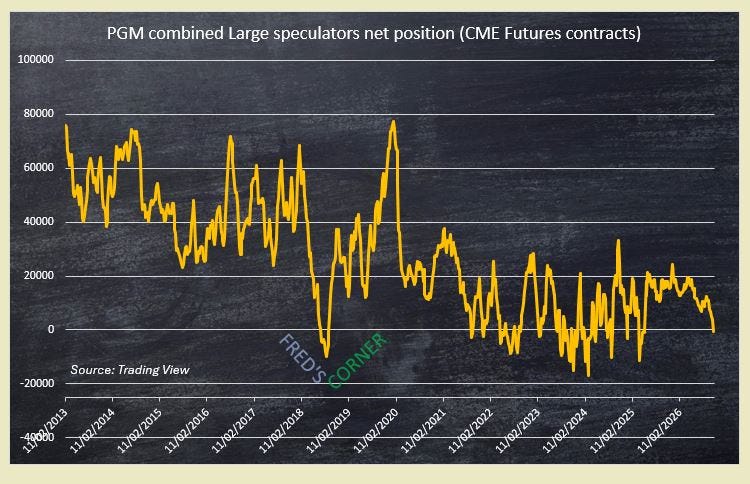
Palladium, unsurprisingly, is showing a large reversal in speculative positioning, which helps explain the price decline.
We have fallen back so fast, though, that at this pace we will soon be close to the historically largest net short position held by large speculators.
Which is remarkable, since supply-demand balances are not pointing to a heavily oversupplied market, and the precious-metals bid could last for years to come (open for debate, but I am very much in this camp).
Platinum itself, which still looks to be in deficit, has also trended back down:
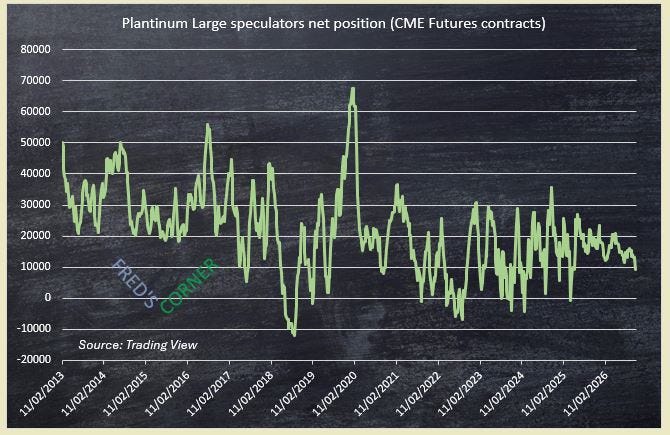
This has left the two metals combined in a slight net short position as far as large speculators are concerned.
Something worth noting:
WHERE LOW PRICES REBALANCES THE MARKET
As I wrote in my article on nickel,
“Commodity markets rebalancing occurs most of the time in a gradual fashion, with iteration between price movements in the underlying, and the price needed for a production response.”
“But given productions costs I am quite confident we will see a production response in the next year or two.”
As with oil, when I wrote a bullish piece at the beginning of February, it’s about risk/reward.
These cost curves from 2024 highlight the point:
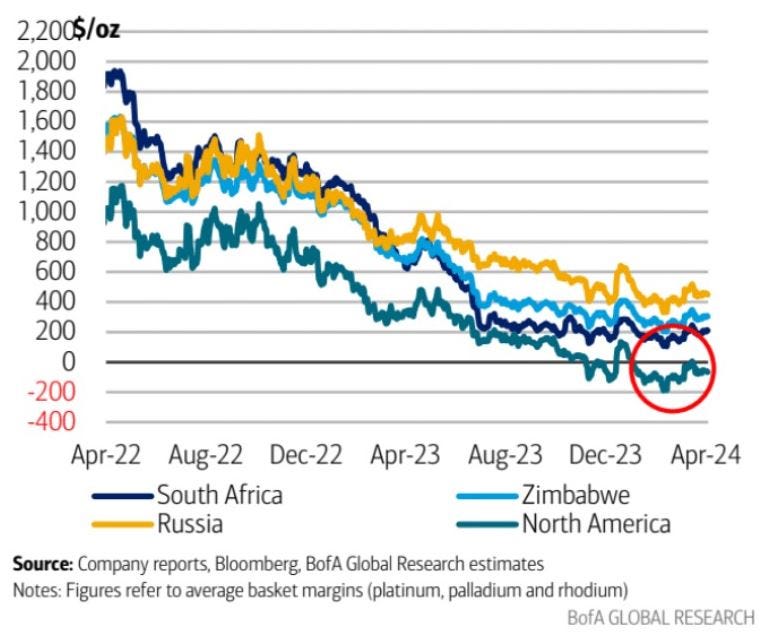
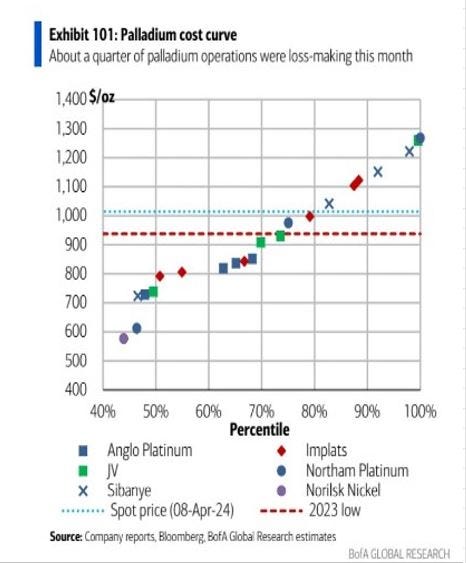
At the time, it looked like the $750–1,050 range would provide massive support.
Where are we in 2026?
Tharisa’s investor presentation gives part of the answer here.
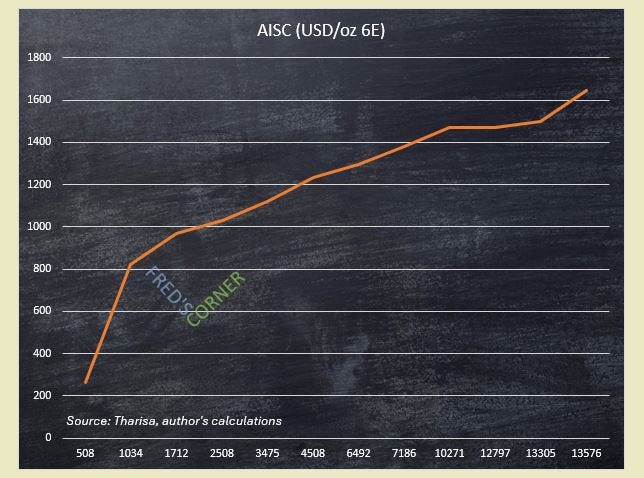
I recreated from their chart the cumulative volume of combined PGM production (x-axis) versus the cost of production in USD/oz.
I know AISC3 is a debatable metric, but I do what I can with what I have!
Given that required production = demand minus recycling, we currently need circa 11.5–12 million oz per year.
That means prices below $1,400/oz are not sustainable at current supply-demand balances.
Platinum is there. Palladium is well below.
And as per the previous cost curves for pure palladium plays, there appears to be a hard floor around $750/oz in South Africa (which, adjusted for inflation, may be closer to $825 now), and mostly above $1,100/oz in the US
RISKS
Automotive trends: As described previously, automotive trends are central to the investment case here. The risk is that EV adoption accelerates significantly compared with what we have seen over the last few years.
But recent trends are rather supportive of holding PGMs.
Broader precious-metals correction: This is probably the risk I am most worried about. I have my own targets for gold, but it seems that persistently higher rates and a steady-to-stronger USD are weighing on the complex for now. I see it as an opportunity, but that’s a very personal view.
CTA pressure: Again, I think positioning is stretched. But my experience in commodities is that CTAs have taken an increasingly large role, and they tend to extend and push trends further than we could have expected. Both ways. It seems bears are really in control now. I am questioning how long and how far this can last
CONCLUSION
I learnt a long time ago that in commodity trading, you cannot time short-term moves using marginal costs, but you can definitely use them to take an investment position.
I think that is where we are with palladium.
Whilst I posted a quick note highlighting the tactical short-term opportunity last week, with the daily RSI below 21 (now 15.8!), this is a dangerous falling-knife-catching game. So far, it’s been a losing position (very short-term).
I am much less concerned about the medium term.
I think we are definitely back in the “penalty box”, that rectangle of consolidation that acted as support in 2023–2025, and I take it as an early Christmas gift.
To each their own list!
As always, remember the DYODD

Do Your Own Due Dilligence !
Thanks for reading,
Fred
WPIC most commonly refers to the World Platinum Investment Council, an international market research and investment promotion organization
PGM lease rates represent the annualised cost of borrowing physical platinum or palladium, typically paid by industrial users, refiners or traders needing temporary access to metal. Rising lease rates generally indicate tightening physical availability, as borrowers compete for limited stocks. Conversely, falling lease rates suggest easing supply conditions. They are therefore a useful indicator of physical market tightness, although they are also influenced by financing costs and market positioning.
AISC stands for All-In Sustaining Cost. It is one of the most widely used measures of mining production costs, designed to capture not only the cash cost of extracting metal but also the expenditure required to maintain existing production.
Funny enough, i got recommend this article from GS Materials daily notes.
It is pretty much the same trade it was in 2024.
For leveraged plays would SBSW or IMPUY work?