


DISCLAIMER:
The article below is part of my “Summer Series”.
As I travel, I have pre-written these pieces to reflect on general trading experiences through a lens I believe may be of interest.
I will admit this one is mainly aimed at a younger audience contemplating a career in finance.
However, it also contains broader lessons about trading and markets.
INTRODUCTION
Most people I grew up with, or meet in everyday life, are generally averse to numbers.
They dislike maths, do not see the point, and have little interest in finance.
When I studied at business school, most students were aiming for marketing roles or consulting positions at one of the Big Four (which probably shows my age!).
Today, when I talk about markets, I often lose people, or I can feel that they perceive it as an esoteric world.
For my part, I fell in love with the trading floor the first time I stepped into one.
The numbers. The adrenaline. The pace.
I first realised I wanted to work in financial markets after experiencing the excitement of the investment club at business school. But I had no family in finance to guide me.
Quite the opposite: most of my family held fairly left-leaning views and did not look favourably on my decision to become a trader.
In this piece, I will share parts of my story as well as some lessons I learned along the way.
The beginning is more personal, but I quickly move into anecdotes that can be generalised into useful lessons for everyday investors and traders.
FIRST, PUT YOUR FOOT THROUGH THE DOOR BY ANY MEANS NECESSARY
From an early stage, I knew financial markets were where I wanted to be.
I cannot fully recall why, but I was drawn to the commodity space. At the time, however, I had very little understanding of what that actually meant.
As I needed to start working quickly after graduating, I took a position as a grain broker in France.
It was a small company, full of old-school brokers with few formal qualifications. It was tough.
But even then, there was already a sense of excitement.
I remember, before starting, watching Boiler Room on VHS.
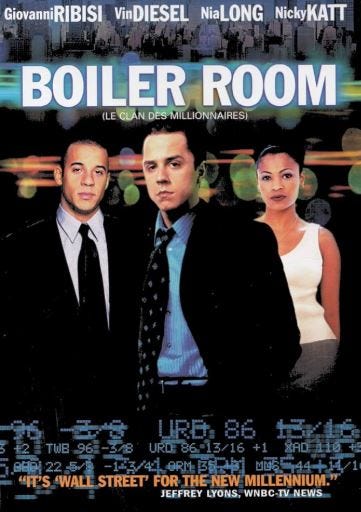
It tells the story of Seth, a young broker who joins a fraudulent stock firm and ultimately chooses integrity over greed.
Not the kind of career you want, nor the kind of firm you want to work for.
But the thrill of it was undeniable.
Anyway, I watched it a number of times I can no longer recall (perhaps just to get into the mood).
Ahhh … good times (lol) !
After a while, and once I realised brokerage was not for me, I reached out to alumni from my business school to ask about becoming a trader.
The answers ranged from: “In France, you can only become a trader if you come from a top engineering school (likely Polytechnique), typically as a quantitative trader at SocGen,” to “You will NEVER become one. The best you can hope for in France is a sales role, if you are lucky.”
I was, to say the least, not pleased. And I did not accept that as an answer.
There was no LinkedIn at the time, but I managed to find the names of traders mentioned in the press, mostly based in London and working at major banks. I would call their front desks, pretending I already knew them, and then aggressively try to connect with them to ask for coffee and learn from their experience.
I also sent out CVs.
Many of them.
It took a lot of effort, especially given the limited means I had at the time (including very little time), but I eventually secured three interviews in London.
In the end, I only managed to land a support position on the electricity trading desk in London. Not exactly a “sexy” market at the time (I had been targeting oil trading). It also came with a pay cut, but I took it anyway, just to be in the middle of the action.
Many others in a similar position at the firm (around 25 people in the team) never made it onto a trading desk, or had to wait two to three years to do so.
I was lucky enough to move into a junior trading role after just four months.
I always say I was lucky to get there, but in reality, it took a huge amount of effort and persistence.
So, my message to young graduates entering the industry is simple:
Go for it. Make your own luck and take bold chances.
Do everything you can to get your foot through the door, by any means necessary.
EXECUTING A TRADE WITH REAL MONEY IS ALWAYS DAUNTING AT FIRST
Back in business school, we had to complete a six-month internship between our second and final years.
With very little network, it was difficult to find one, but I eventually secured a sales position at Crédit Lyonnais (now CACIB) on the rates and FX trading floor.
We mainly received FX orders from clients in London, which we had to transmit via a squawk box1.
The traders were actually sitting only five to ten metres away from us, but that was the procedure for passing orders (likely for compliance reasons and to ensure voice recordings were available in case of errors or disputes).
I still remember how stressful those first few orders were.
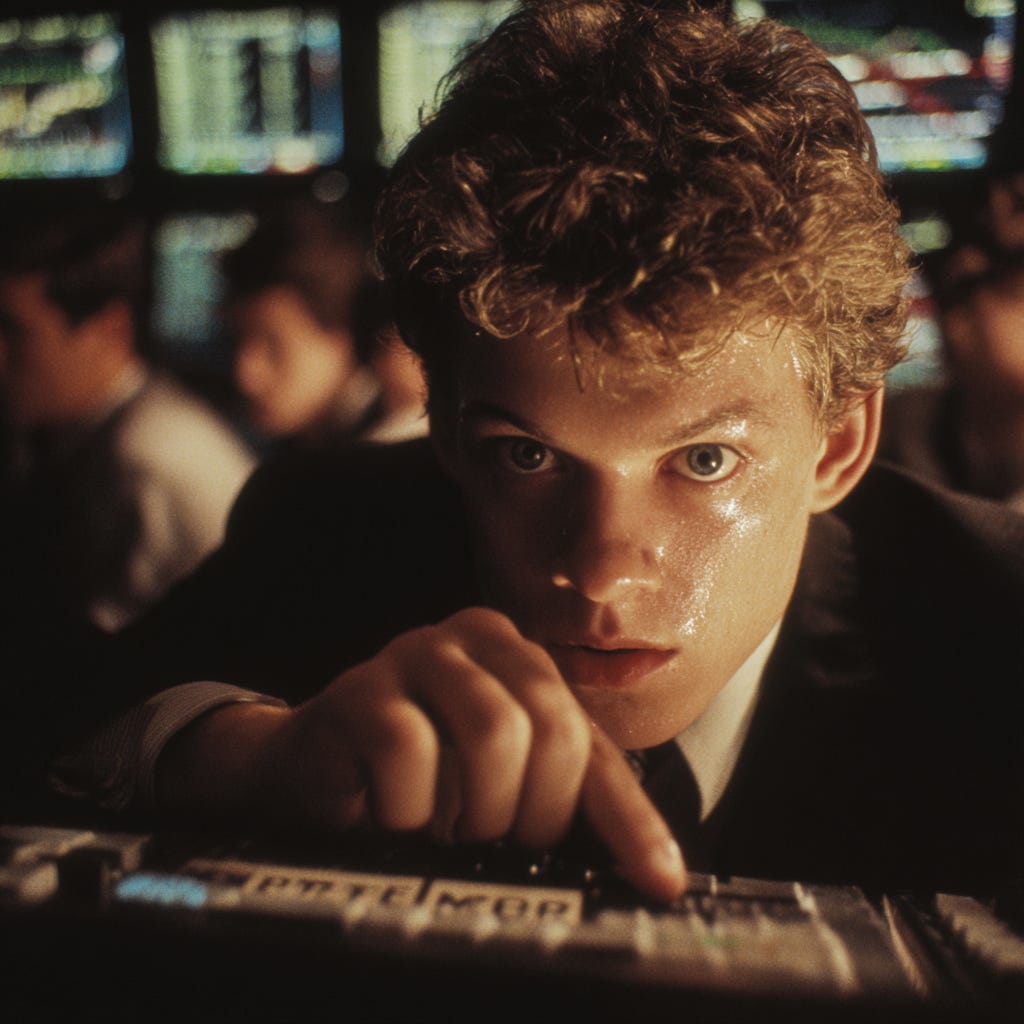
Or the day I had to execute a €50 million EUR/USD order, which, in itself, is not particularly large in market terms.
Similarly, when I started trading power in London, I remember being extremely cautious with every order entry, triple-checking everything I input on the screen, even the smallest trades.
In hindsight, that was probably a good thing, given, as I described in Trader’s Esperanto, every trade would effectively be “held” by the market.
It feels like light-years away now.
By the end of my career, I would transact tens of millions in power in a split second, without a second thought about the mechanics of transmitting my intent from brain to market via a keyboard.
I am sure some experienced traders may not see the point of describing all this, but to younger readers I would say the following: if you ever start on a trading desk, take your time, confidence and speed will eventually come naturally.
YOUR BRAIN SLOWLY REWIRES ITSELF TO PROCESS INFORMATION
Another overwhelming aspect of trading was processing market prices in real time.
On power and gas, I would stare all day at two screens showing around 100 to 150 products, each with bid and offer prices, without even seeing the full depth of the market.
Every time a trader adjusted a price, it would flash.
It was literally flashing like a Christmas tree.
I vividly remember focusing hard on it, struggling to make sense of the constant movement. Naturally, your attention is drawn to the flashing lights, and by the time you look at the product you care about, your attention has already been pulled somewhere else on the screen.
Yet gradually, something changes. I would find myself looking at the centre of my screen, usually an Excel sheet, while still perceiving the flashing movements in my peripheral vision and instinctively knowing which markets were moving and in which direction.
At one point, I had six to eight screens: two for Excel, one for Bloomberg, one for weather models, and two dedicated to prices. Sometimes I would add extra screens, or remove some to make space for more Excel, or include additional data providers such as Reuters (now Refinitiv/Eikon).
The lesson is simple: stick with it.
I genuinely thought I would never adapt to that information flow, but after 12-18 months, my brain had effectively learned to process it in the background.
So yes, our brain really does rewire itself.
IT’S HARD WORK, HARD WORK, HARD WORK
The best have said it. Stanley Druckenmiller has repeatedly testified that it takes incessant hard work to stay at the top.
Even without being at the top myself, I can echo that sentiment from personal experience: it is fundamentally about hard work.
I was never the brightest, nor did I attend the most prestigious school on the desk.
But I believe I had the most important trait for success in this business: an enormous drive to succeed, and the willingness to work harder than most.
I had to wake up at 5:45 am and be in the office by 6:30 am every day for 15 years.
I spent almost a full year working weekends in the office, rebuilding spreadsheets left behind by a senior trader who abruptly left our desk and put me in charge. It was a huge opportunity, but also an enormous amount of work.
Stress never really went away. Holidays? Very rarely. Yes, I did travel, but I also spent a full week on the phone during my honeymoon while the market moved against me.
I was short gas and then power when Fukushima happened, and had to manage stop-outs and rapidly reshuffle positions after a night out in a Paris club, while I was supposed to be on holiday trying to disconnect.
I was always on the phone, skiing, travelling to the West Indies with my family, even in the delivery room at the hospital when my first son was about to be born.
So yes, it is an intense profession, but it requires constant focus and relentless effort.
This is not meant as a warning. My view has always been: try it, and see what happens if you get the chance.
It worked for me. It did not work for many.
CUTTING LOSSES IS A SUPERPOWER
Cutting losses is extremely difficult when you start.
We are simply not wired to do it.
But over time, you learn.
My lesson is simple: the faster you cut, the better it is, not only to minimise losses, but also to clear your mind and give yourself the opportunity to come back.
With experience, I became quite quick at it.
One example comes to mind.
I was short Dutch power versus German power, a typical location spread trade in the power markets.
The Dutch market was heavily influenced by Belgium, and vice versa, especially after some nuclear capacity closures in Belgium.
That afternoon, I not only stopped out of my original position (which had been intended as a medium-term trade of a few months in my world), but I also effectively reversed it.
I went long Belgium and the Netherlands versus neighbouring markets such as France and Germany, again, a classic relative value setup.
It worked out extremely well and ended up making my year.
In the end, it simply required swallowing my pride and getting out quickly.
It was not painless, but it paid off significantly.

WHAT IS MY BEST TRADE / BEHAVIOUR?
I was recently listening to the excellent Market Huddle podcast, where Kevin Muir interviewed Tony Greer.
He asked him about his best and worst trade, and I want to share mine.
My best “trade” is not a trade in itself, but rather a behaviour, something that I saw consistently among successful traders around me, and that I also experienced personally.
To me, it is what defines a real trader and separates them from someone who has not yet been properly tested.
It is about how you come back from a drawdown.
I had the displeasure of digging myself out of a number of holes.
Cut, cut, cut. Patiently stabilising and rebuilding the P&L, eventually managing to end the year in the green and meet targets.
I remember some years when it was extremely painful, long, slow, and requiring everything I had. But I got through it.
On the other hand, I saw traders given significant risk-taking responsibility, who had a few good years, received praise from management, and then one day, after four or five years, they suffered a large loss.
And they simply froze.
I was once asked by management to take over someone’s book, helping execute and manage risk for a colleague who could no longer do it.
I did my best to support both the trading book and the individual mentally, but in the end they chose to leave the industry.
So yes, the real test, and what I am most proud of, is the ability to recover.
It truly tests your resilience and your nerve.
MY WORST TRADE (OR MISTAKE)
I don’t have one (laughs).
Ok, let’s be serious.
Again, it is less about a single trade and more about behavioural mistakes.
One is being “too cute”, i.e. not doing your homework properly.
By “cute,” I mean taking positions without putting in the necessary work, such as making a speculative weather-driven power trade with size and no real edge.
Another mistake, in the same vein, is following someone else’s idea.
If there is one key lesson, it is this: never, ever do that.
I am not referring to a broker pitching a trade. I am referring to entering a position without having done your own fundamental analysis and developed your own conviction.
I earned significant respect in the power markets by being very rigorous in my own analysis.
We had a strong team of power traders during my best years between 2008 and 2012. Very sharp, very competitive.
But one thing I believe we got wrong was our weekly trading meeting.
Each trader would give a 2-5 minute summary of their market view and ideas. The head of trading would go around the room and ask the six senior traders to present.
In hindsight, I realised that my closest friend in the business often deliberately avoided these meetings. He later admitted to me that he would frequently find excuses not to attend.
He simply did not want to be influenced by others.
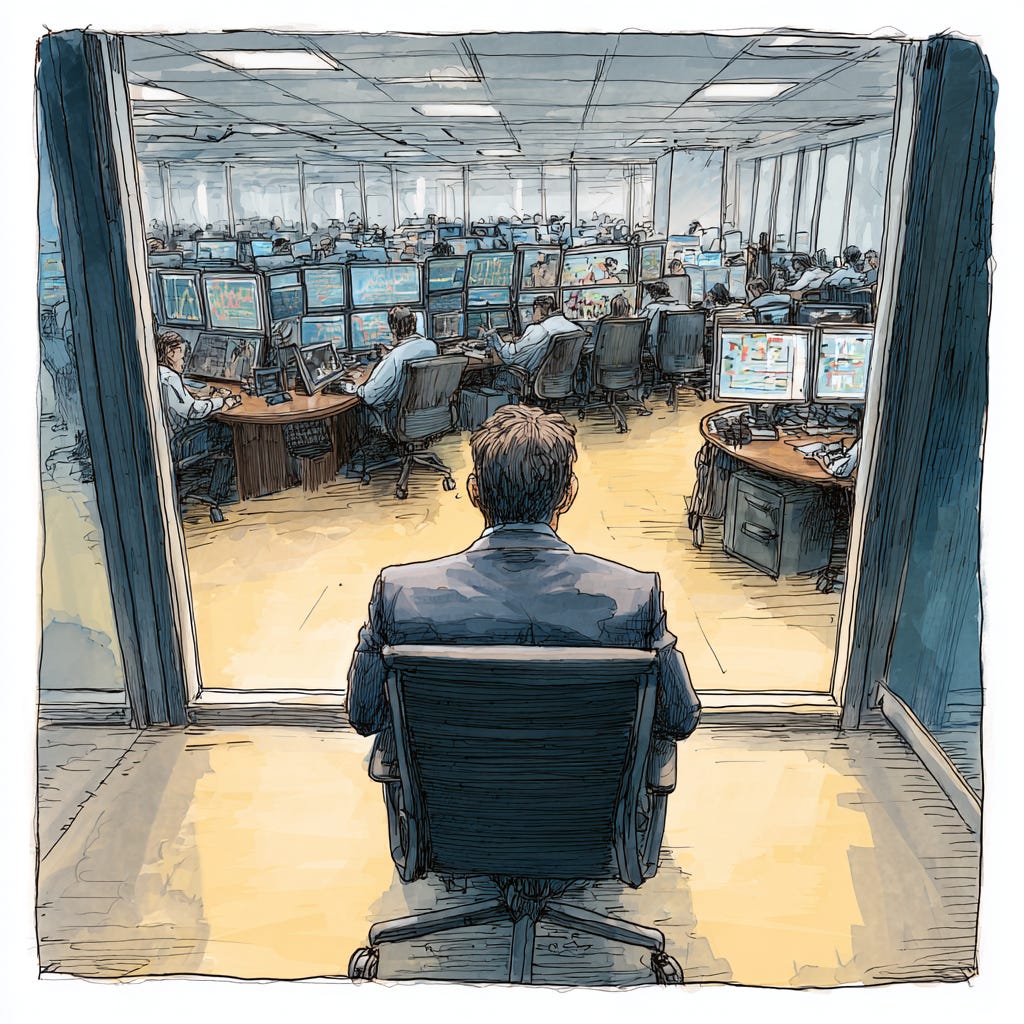
He was absolutely right.
Even though we all did our own homework, it would happen (once a year, often around early April) that we would all end up in the same positions.
All of us.
And more often than not, that is precisely when disaster struck.
This is why distancing yourself from the herd is such an important behavioural trait.
Sharing ideas is extremely valuable, as other traders and analysts can help fill in parts of the picture you may be missing.
But you should not discuss positions.
Discuss flows instead.
CONCLUSION: EMOTIONAL INTELLIGENCE SKILLS ARE KEY
I do not want to make this section too long, as I already failed at that in the previous article.
That said, I would like to add a couple of additional points:
You are on your own: even within a firm or team, competition is fierce. Be aware of it. But if you find a mentor, do everything you can to learn from them and absorb as much information as possible.
Trust the process: forget daily P&L. It will fluctuate significantly. Focus instead on doing high-quality fundamental work and be patient in building or holding positions. It will pay off over time.
My main conclusion, if you want to become a trader, is that emotional intelligence matters more than raw intelligence.
Yes, financial knowledge and coding skills are important.
But you will NOT become a successful trader simply by having a top degree. It matters far less than people think compared to the “average” person with the right traits.
What matters is:
the ability to cope with and thrive under stress
hard work
resilience
and a strong drive and ambition
When I used to interview candidates for trading or trading support roles, I would always try to assess these three traits:
Do they genuinely look like they will do whatever it takes to succeed (drive)?
Can they demonstrate experience in stressful environments or situations?
Are they clearly hard workers?
Of course, these are extremely difficult things to prove in an interview.
But if you are considering a career in trading, my two cents is this: you need these qualities to succeed.
Thanks for reading,
Fred
You can refer to my previous article [Link] but a box is a permanently open, always-on intercom or loudspeaker system used for instant communication. Mostly with brokers but here with traders on my floor.
Really interesting article. In my early years, I was lucky enough to get a clerk’s job on the equity trading floor at CIBC (1999-2000). I didn’t last long (less than a year) as the pressure was not for me. I stuck with the concept of trading though, and reinvented my approach after reading Michael Covel’s Trend Following. Covel’s book was life changing for me, and allowed me to redefine what I thought trading meant. I ended up moving towards systematic trading and have never looked back. No screens, no intra day decisions, everything is coded and systems run in the evening. For me, this works.
Great article Fred !